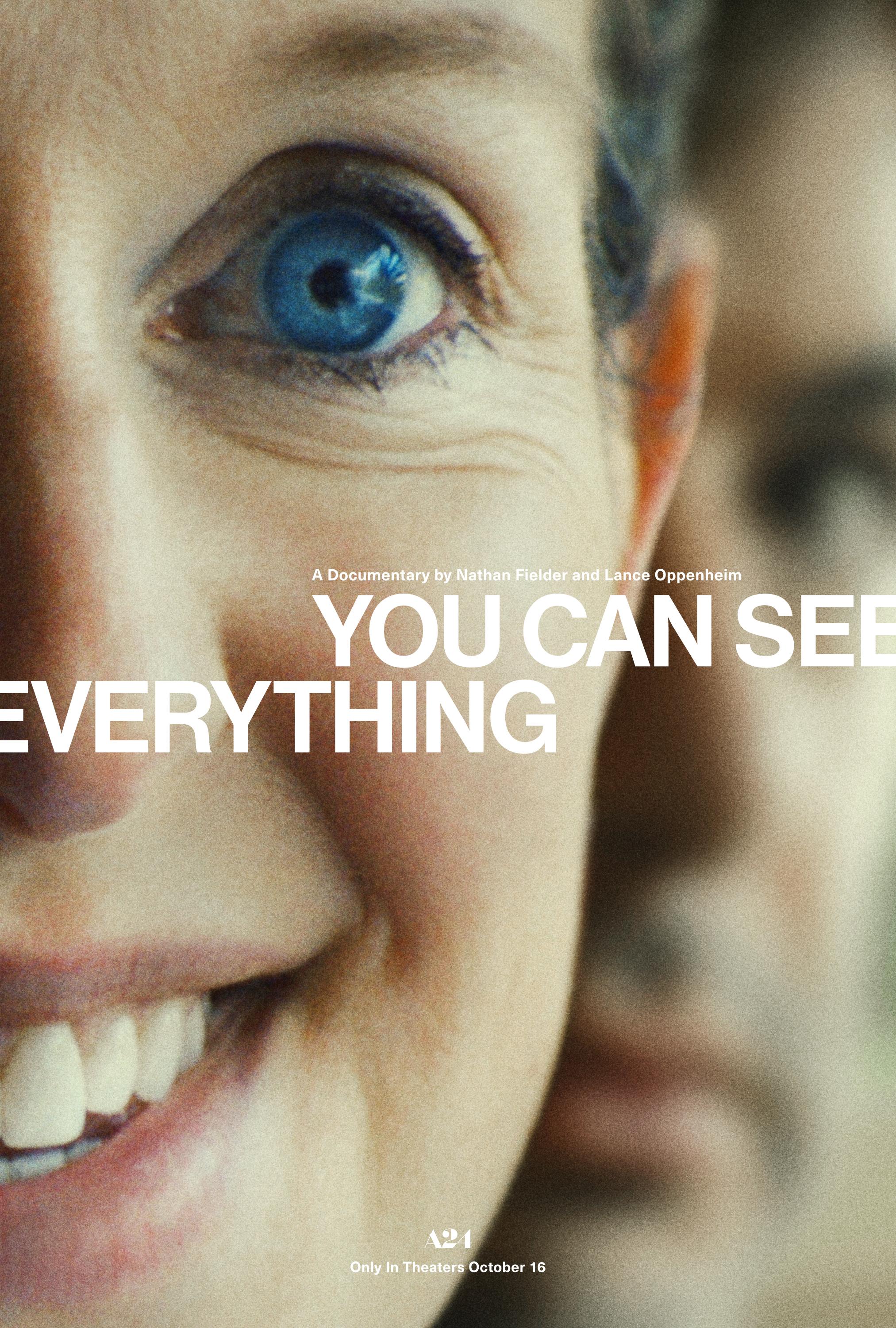
You Can See Everything
I’ve never seen a film quite like You Can See Everything. It starts off as a fairly straightforward documentary before morphing into something entirely different – a meta commentary about its primary subject and also about how we define the concept of “truth.” I wouldn’t dream of spoiling any of the shocking events that transpire, although I will tell you why this may be the most quintessentially American film of our time.
The subject is Elizabeth Holmes, former CEO of Theranos. Her company claimed to have invented a machine that could carry out a series of tests from just one drop of blood. That wasn’t true, leading to the fraud convictions of Holmes and business partner/former boyfriend Ramesh “Sunny” Balwani. In the weeks leading up to her incarceration, Holmes and husband Billy Evans invite comedian Nathan Fielder and documentarian Lance Oppenheim (Primetime) into their home, promising total unfiltered access. Their goal is clearly to change the narrative on Holmes, who repeatedly insists she never intentionally defrauded anyone.
The first hour of the movie finds Fielder using his blunt style to grill his subject on Theranos, her criminal record, and the public’s perception of her. Evans skirts around the edges, inserting himself whenever he thinks his wife requires protection from uncomfortable questions. You lean in during these scenes, trying to determine if Holmes is sincere in her denials or simply pulling another master manipulation. Her demeanor is odd, to say the least. A suggestion exists that she might be neurodivergent. Again, though, is that real or an act? An eerie quality permeates the film, as you wonder if, like Theranos’ investors, you’re being scammed. The facts of the case are conclusive; she nevertheless manages to blur the lines with her "I'm just a normal wife and mother" assertions.
Then Holmes reports for prison and You Can See Everything evolves into something strange, peculiar, and thoroughly mind-blowing. Fielder and Oppenheim continue to follow Evans as he attempts to launch a new business. They also bring in actress Amanda Seyfried, who won an Emmy playing Holmes in Hulu’s series The Dropout. She participates in reenactments of events the cameras aren’t allowed to record, as when Fielder visits Holmes in prison. In other scenes, Fielder and Seyfried analyze the relationship between Holmes and Evans, which contains dynamics that can be tough to wrap their heads around.
Running a fast-paced three hours, the film works as a true story packed with unexpected twists and turns, the kind that make you jolt upright in your seat and think, What?! Fielder and Oppenheim capture some remarkable sights and have stunning interactions with Holmes and Evans. There are moments when I couldn’t believe the movie really existed. Like a masterful detective story, you hang on every new development with bated breath.
Beyond that, the documentary speaks powerfully to our era. Stephen Colbert coined the term “truthiness” to indicate the phenomenon where people believe something is true based on personal feelings/bias rather than on facts. We live in a time when AI makes it hard to tell what’s real and what’s fake. Providing disinformation has become a cottage industry on social media. A frightening percentage of people get their news from Facebook, TikTok, and YouTube – outlets where it’s all too easy to fall for fake news, thanks to algorithms that create echo chambers.
You Can See Everything deals with the damage truthiness has inflicted upon society. Holmes wants to be seen in a different light. Evans wants to vindicate her. How much of what we witness is real? Are they being sincere or merely executing a PR spin? Fielder and Seyfried grapple with those questions, as do we. Layers upon layers of uncertainty about Holmes pile on top of each other, leaving you feeling a certain way one minute, an entirely different way the next. By the end, we’re left with our heads spinning. After my screening, I had a 10-minute conversation with a complete stranger. We both needed somebody to help us process what we’d seen. It’s that kind of picture. Discussion and debate afterward are inevitable.
The mysteries inherent in the Holmes/Theranos case are countless. That’s why the running time flies by. You Can See Everything envelops you in a maze of riddles, leaving you enthralled and mesmerized from beginning to end. I’ll be thinking about this cinematic masterpiece for weeks – if not months or years – to come.
out of four
You Can See Everything is rated R for language and some graphic nudity. The running time is 2 hours and 54 minutes.
© 2026 Mike McGranaghan