"Wuthering Heights"
Warner Bros. is insisting quotation marks be used when writing about “Wuthering Heights”. That seemed pretentious to me at first. Now that I’ve seen the film, it feels much more appropriate. Anyone coming to this expecting a straight, traditional adaptation of Emily Brontë’s novel will be disappointed, and possibly enraged. Writer/director Emerald Fennell (Saltburn) takes the basic premise, then deviates liberally from the text to tell her own erotic version of the story. This movie is so sexed-up that if you watched it from a D-Box seat, you’d probably need a cigarette afterward.
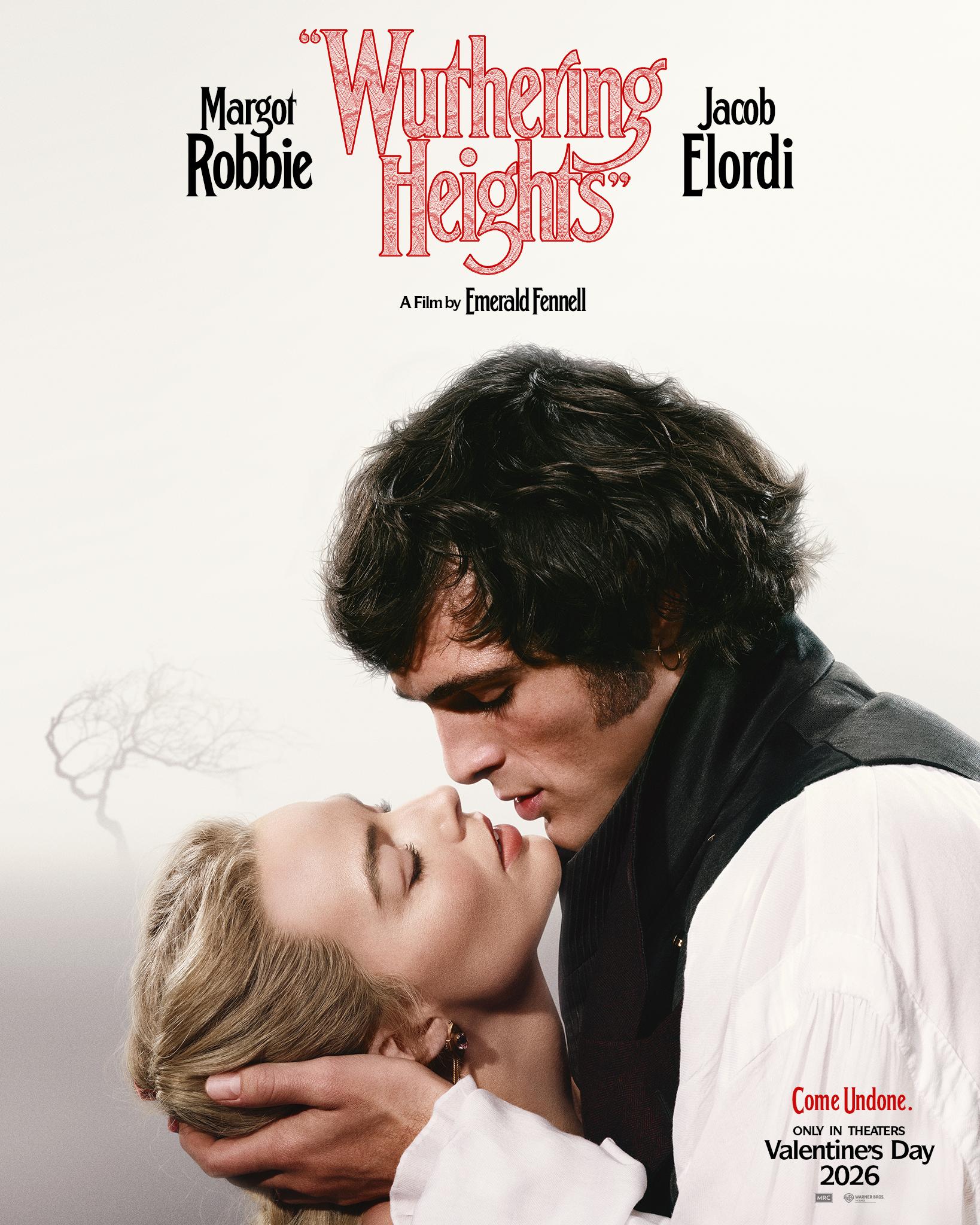
Cathy (Margot Robbie) and Heathcliff (Jacob Elordi) have been close since childhood. As adults, a very strong attraction exists between them, but neither has ever owned up to it. Now that her family’s money is gone, Cathy makes a play for the wealthy Edgar (Shazad Latif). Heathcliff, believing she has no feelings for him, disappears, only to return years later to stir things up again. They begin a passionate affair that her servant Nelly (Hong Chau) tries to sabotage. An inability to properly get together causes both to behave somewhat erratically.
Fennell’s take on Brontë’s tale seems to be that lust can drive you cray-cray. She makes that point by filling “Wuthering Heights” with sex and sexual imagery. Hands fervently kneading dough, Heathcliff seductively running his fingers through an egg yolk, and other sights ensure the aura of sensuality is perpetually hovering over the plot. That’s in addition to a bondage-related sex scene and a steamy bit of lovemaking between the leads with a Charli xcx song playing on the soundtrack. Everybody here is horny all the time.
The approach is effective because attention is paid to the emotional state of the characters. Cathy and Heathcliff cannot get on the same wavelength at the same time, leading to scenarios where they have inner torment over not being together. Several factors, most notably her marriage to Edgar, divide them further, thereby increasing their respective unhappiness. The movie captivatingly explores the psychological toll it can take when two lovers are kept apart by fate, bad decisions, and/or an inability to communicate reasonably.
Pre-release, the casting of Jacob Elordi generated mild controversy, given that the novel infers that Heathcliff is not white. That’s a valid point; however, it does nothing to negate the power of Elordi’s performance. The way he portrays this man’s transformation from servant to master is convincing, and we can see how getting hurt by Cathy clashes with his aching love for her. The actor has hot chemistry with Margot Robbie, who provides Cathy with a tempestuous personality that often trips her up. She is raw and real throughout.
Tonally, the picture fluctuates. Certain scenes are lightly comedic, others borderline melodramatic, and still others lean heavily on realism. At points, you have to wonder if Fennell is doing this deliberately or if she just can’t decide on a tone. Then again, that works to the film’s advantage in some ways, never letting viewers become complacent. Creative production design - sets, costumes, etc. - assists in establishing an elevated world for the characters’ bold actions to take place in.
The biggest flaw is a short section wherein Heathcliff becomes super-dark with Edgar’s ward, Isabella (Alison Oliver). What he does is sufficiently weird that you briefly lose empathy for him. Thankfully, “Wuthering Heights” gets back on track for the finale, which, considering the sexual nature of the movie, hits you right in the heart. Let the purists balk. This is a fresh interpretation of a frequently adapted classic, and it succeeds well enough as both titillation and romantic entertainment.
out of four
"Wuthering Heights" is rated R for sexual content, some violent content, and language. The running time is 2 hours and 16 minutes.
© 2026 Mike McGranaghan