The Story of Everything
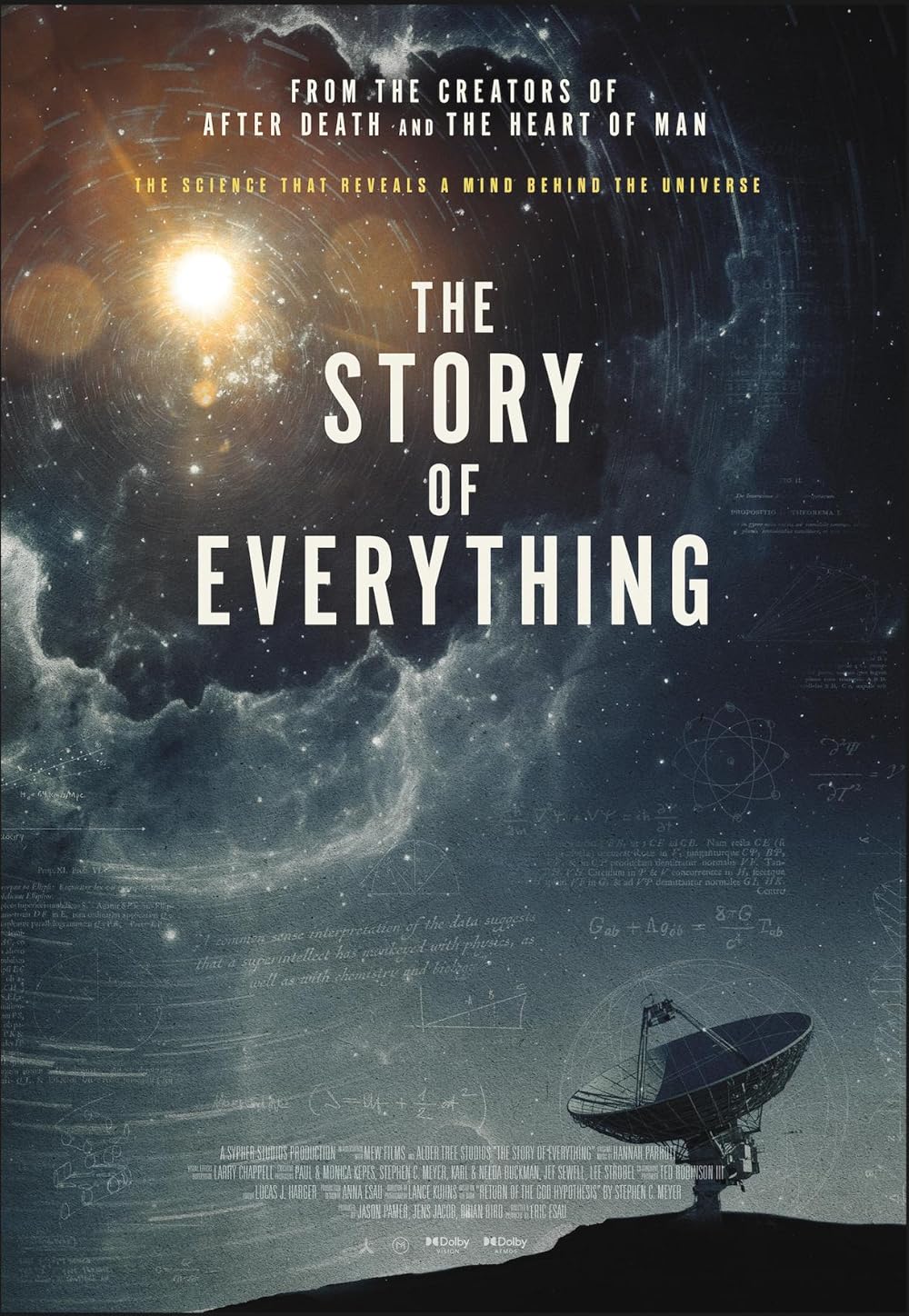
I felt a tinge of trepidation going into The Story of Everything. I knew the film dealt with the eternally compelling question of the universe’s origins and was going to take a pro-intelligent design position. Less clear was whether it was seriously going to deal with that question or simply use it to advance a religious agenda. Surprisingly – and very much so – this is a scientific documentary through and through. There’s no sermonizing whatsoever. For that reason, it deserves to be seen by a wide audience of people who are willing to open their minds to the evidence.
Director Eric Esau and producers Jason Pamer (After Death) and Jens Jacob bring together a group of experts in various fields to explore whether the universe was created through a random, unorganized sequence of events or if there are signs of a designer. Participants include philosopher of science Stephen C. Meyer, Oxford mathematician John Lennox, cosmologist Brian Keating, and astrophysicist Luke A. Barnes, among others. Using easy-to-understand metaphors whenever possible, they explain complex scientific principles that suggest randomness simply doesn’t make sense. That idea is explained through multiple prisms, but the conclusion is the same: randomness is likely to produce a system inhospitable to life. Chaos does not lead to functionality of the type found in our universe, our bodies, or our environment.
As another example – and I am by no means scientifically intelligent enough to write this with the eloquence it deserves - it’s pointed out that the universe is expanding, which must mean that it was previously more compact. If you follow mathematic principles and take it backwards, you end up at a point where energy is insufficient to create anything. Only through an exterior energy source would the process of creation begin to start.
Again, this is all presented through science. The Story of Everything smartly uses onscreen graphics and illustrations to help viewers visualize anything not easily grasped through technical jargon. The film is very persuasive in its argument, mounting it from several perspectives. A section on DNA is particularly powerful, as it suggests the intricately detailed nature of genetics is so elaborate that the idea it came about randomly is beyond improbable.
If there’s a downside, it’s merely that taking in this much scientific information in 100 minutes proves mentally taxing after a while. My brain became tired from trying to hold all this knowledge. First-rate production values help keep things visually lively, but there’s no denying the movie leaves you a bit exhausted.
Will The Story of Everything win any new converts to the idea of intelligent design? It may well. Doubtlessly, there will also be people who attempt to poke holes in its theory. The mere fact that the documentary exists is a reason to celebrate, though. The origin of our world remains mysterious. Taking a hard scientific look at it, examining the evidence, and debating the meaning is important, no matter where you end up landing on the topic. Prepare to be challenged, provoked, and thoroughly fascinated.
out of four
The Story of Everything is unrated, but contains nothing objectionable. The running time is 1 hour and 40 minutes.
© 2026 Mike McGranaghan