Soul on Fire
Soul on Fire is a reminder that just because a true story is inspiring doesn’t mean it will automatically make for a good movie. The real-life events need to be placed in the hands of people who will dig deep, rather than merely coasting on the inspirational value. This faith-based drama was written by Gregory Poirier, whose body of work includes uninspired fare like See Spot Run and The Spy Next Door. Its director is Sean McNamara, the man responsible for some of the most ineptly made pictures of recent times, including Vindicta, The King’s Daughter, and Reagan. Together, they turn a potentially profound tale into a shallow, simplistic bore.
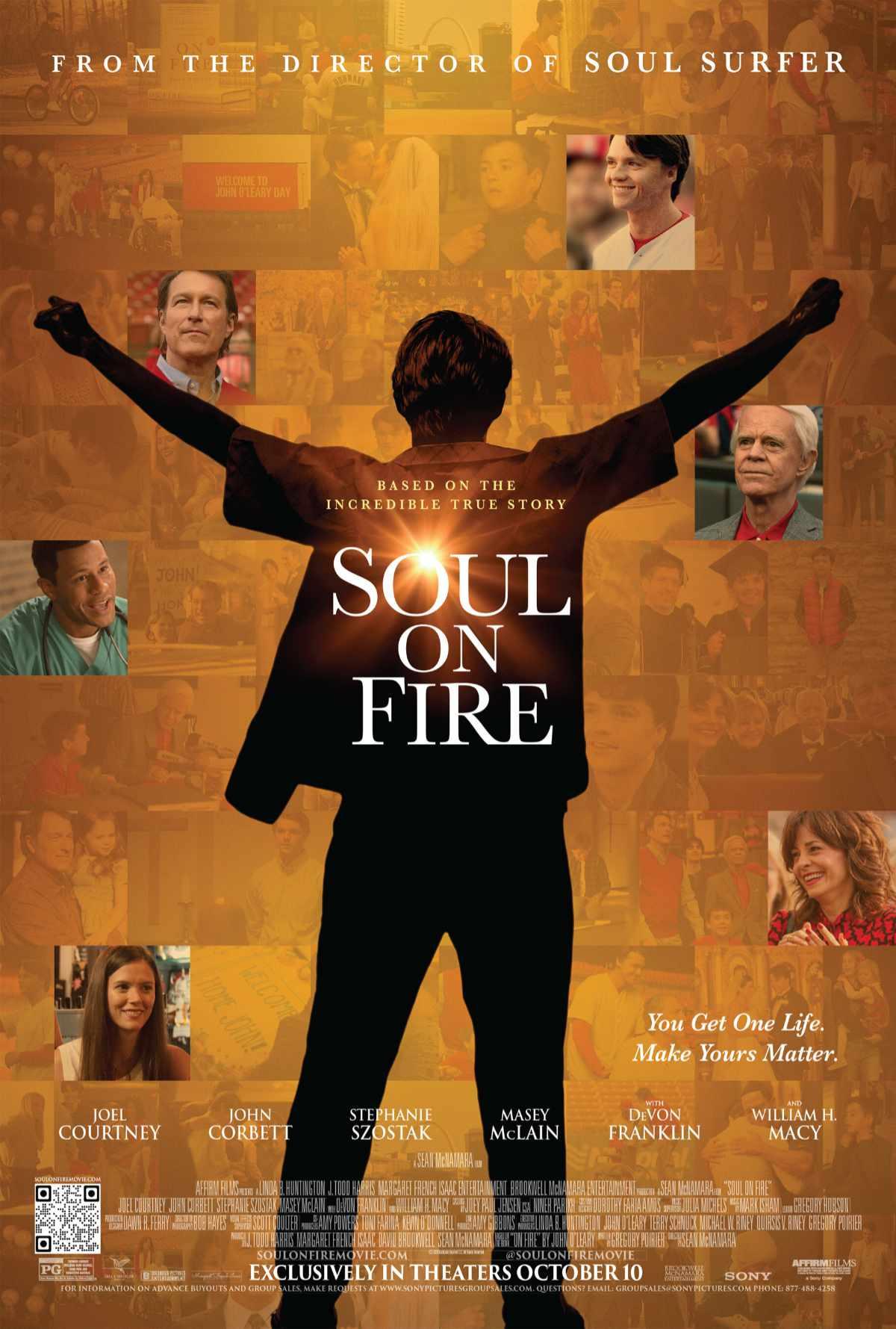
The movie is based on the life of John O’Leary, who suffered severe burns over 100% of his body after accidentally setting his family’s home ablaze as a child. While in the hospital, the baseball-obsessed boy is frequently visited by famed sportscaster Jack Buck (William H. Macy). Buck, having been moved by the tragedy, offers messages of encouragement. As a young man, John continues his friendship with Buck, while simultaneously pining for gal pal Beth (Masey McLain), dealing with the illness of his father Denny (John Corbett), and beginning an unplanned career as a motivational speaker.
What we’re supposed to get out of Soul on Fire is the message that, through God’s strength, we can get through any challenge, no matter how devastating. Unfortunately, Poirier’s screenplay conveys that message in soap opera style. Everything is presented as a platitude, with no effort to realistically mine the complex emotions that would arise from being a burn victim looking to overcome insecurity and find purpose in life. Nowhere is that more glaring than in a scene depicting John and Beth’s wedding night where, in preparation for lovemaking, he reveals his scar-covered body to her for the first time. This could have been an insightful, choke-you-up moment, but it’s portrayed with all the passion of opening a jar.
McNamara similarly stages everything in a relentlessly schmaltzy manner. The fire scene is marred by cheap visual effects. A later sequence, involving an auto mishap on an icy road, is equally amateurish. Zero suspense is generated from either of these events. In terms of pace, the film alternately drags and feels as though it’s being rushed, leading to the perception that the director had no overarching vision for telling John O’Brien’s story.
The acting isn’t much better. William H. Macy gives a sincere, subtle turn as Jack Buck. Everyone else in the cast pitches their performance at an elevated level, especially several of the supporting players. Which is to say the overacting here is pretty distracting. Especially in a human-based story like this, it’s vital for the characters to come off like real people. Buck aside, these characters talk and behave so artificially that it undermines the fundamental meaning of John’s journey.
The shocking thing about Soul on Fire is how little thought seemingly went into it. An excess of sappiness harms every aspect of the movie, and the religious theme is shoved in at the end, as though that will compensate for the sloppy inconsistencies (like how the O’Brien house is supposedly burned the ground but immaculately rebuilt in just five months). Faith-based cinema has progressed impressively over the past decade. This entry, however, is a big step backward.
out of four
Soul on Fire is rated PG for thematic content including burn injuries, some peril, and suggestive material. The running time is 1 hour and 51 minutes.
© 2025 Mike McGranaghan