Sorry/Not Sorry
In November of 2017, I screened I Love You, Daddy, a feature film written by, directed by, and starring Louis C.K. Two days later, the New York Times published a bombshell article detailing C.K.’s penchant for forcing unwilling female comedians to watch him masturbate. The movie’s release was abruptly canceled. I’d heard the rumors before that, which is what made I Love You, Daddy so shocking. The story is essentially a treatise on why we should humor men in acting out their perversions. I stopped being a fan the moment I laid eyes on it.
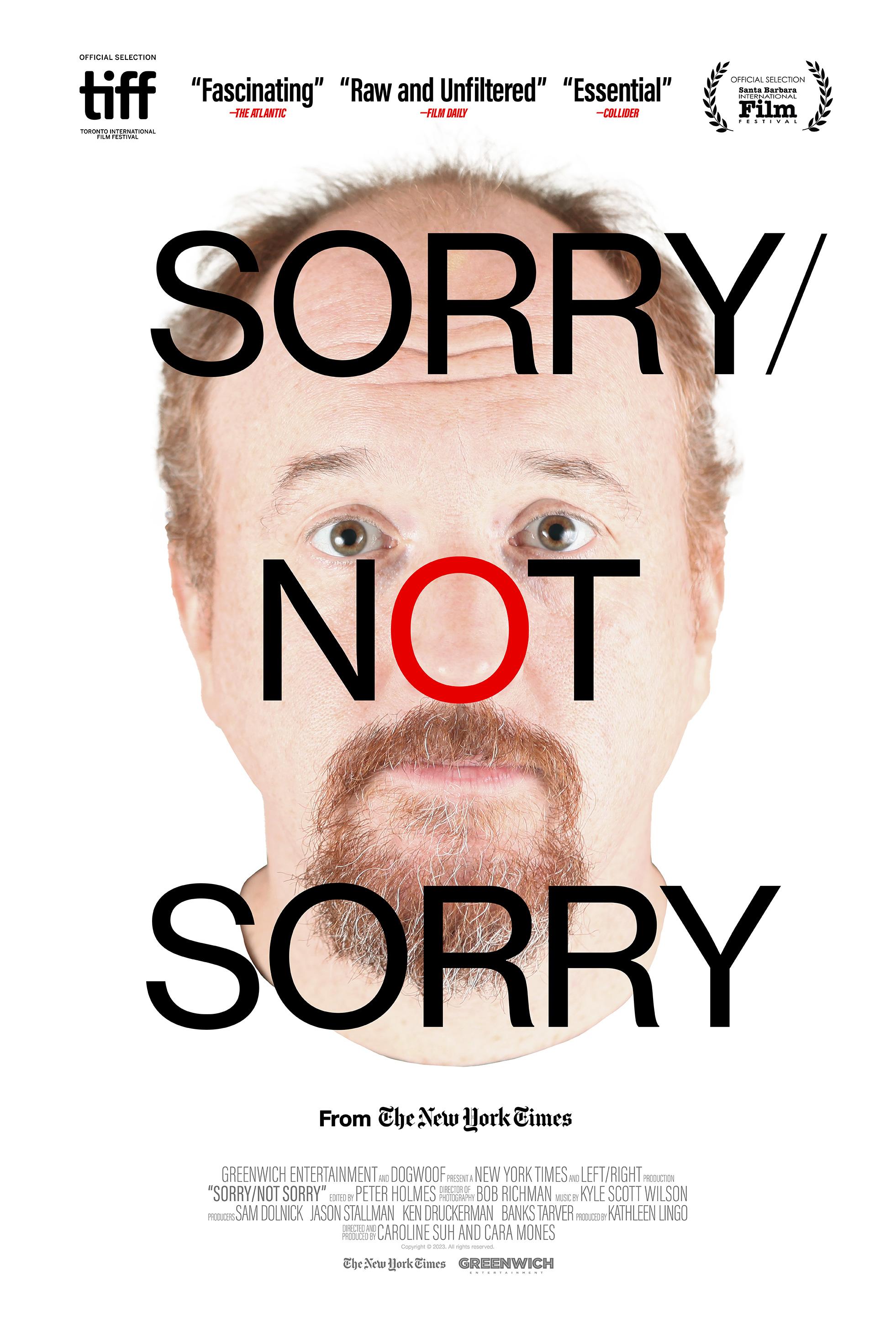
Sorry/Not Sorry is a probing documentary that looks not only at C.K.’s actions but also the erratic public reception to them. Directors Cara Mones and Caroline Suh interview three of his accusers – Jen Kirkman, Megan Koester, and Abby Schachner. They detail their interactions with him, which of course are fascinating in a prurient way. More fascinating, though, are their comments about how their perceptions changed over time. Hearing that they were not alone helped to bring into focus that C.K. wasn’t just awkwardly flirting or “doing a bit.” He was an unrepentant abuser.
Also interviewed are the journalists who wrote the article, the owner of the comedy club C.K. regularly performed at, and fellow show biz folks (including Parks & Recreation showrunner Michael Schur) who were aware of the rumors. Their comments help to tell the story within the story, namely that C.K. was such a comedy giant at the time that many individuals in his orbit were unintentionally quick to excuse away his behavior. One of the reporters points out that if, for example, a senior bank manager started masturbating in front of an employee, it would be viewed as traumatizing. When a master funny man does it, however, there was a willingness to chalk it up to a personality quirk. The film does a very good job exploring the way fame dulls the edges of how inappropriate actions are perceived.
A theme of victim-blaming emerges partway through Sorry/Not Sorry. Kirkman reveals that she received so much hatred for talking about what C.K. did that it became overwhelming. Schachner became the butt of a joke made by Dave Chappelle on a Netflix special; he mocked her for not simply hanging up the phone upon realizing C.K. was jerking off during their discussion, as if she was the problem. You come away with a strong sense of why women are often reluctant to report sexually inappropriate behavior. They know there’s a tendency to circle the wagons around the culprit with money, fame, and/or talent.
The documentary’s final section details Louis C.K.’s comeback. Mones and Suh interview fans outside his sold-out show at Madison Square Garden. A provocative question arises. How long should an artist be “canceled”? What’s the proper length of time? What’s the sufficient level of atonement? Obviously, there are no easy answers to that. C.K. has largely painted himself as the victim in this scenario, his on-stage routines a virtual “F you” to the women he made uncomfortable. Should we even offer forgiveness without contrition?
Sorry/Not Sorry may be about Louis C.K., but it’s also about so much more. The film is a meditation on how our society grapples with mega-talented stars who do things in their personal lives that are sketchy or immoral. Whether it’s C.K., Jonathan Majors, Mel Gibson, or a host of other celebrities, we’ve repeatedly had to ask ourselves where we draw the line. In that sense, this is a documentary that speaks meaningfully to our fame-obsessed time.
out of four
Sorry/Not Sorry is unrated, but contains strong language and mature subject matter. The running time is 1 hour and 30 minutes.
© 2024 Mike McGranaghan