The Phoenician Scheme
Wes Anderson is arguably the most visually distinctive director working today. He could leave his name off the credits of his films and you’d still know exactly who made them. For that reason, he is sometimes criticized for telling stories that are empty or emotionally vacant. I don’t believe that’s even remotely true, and The Phoenician Scheme proves it. Underneath the trademark quirkiness is a heartfelt father/daughter tale that’s all the better for not taking a conventional approach.
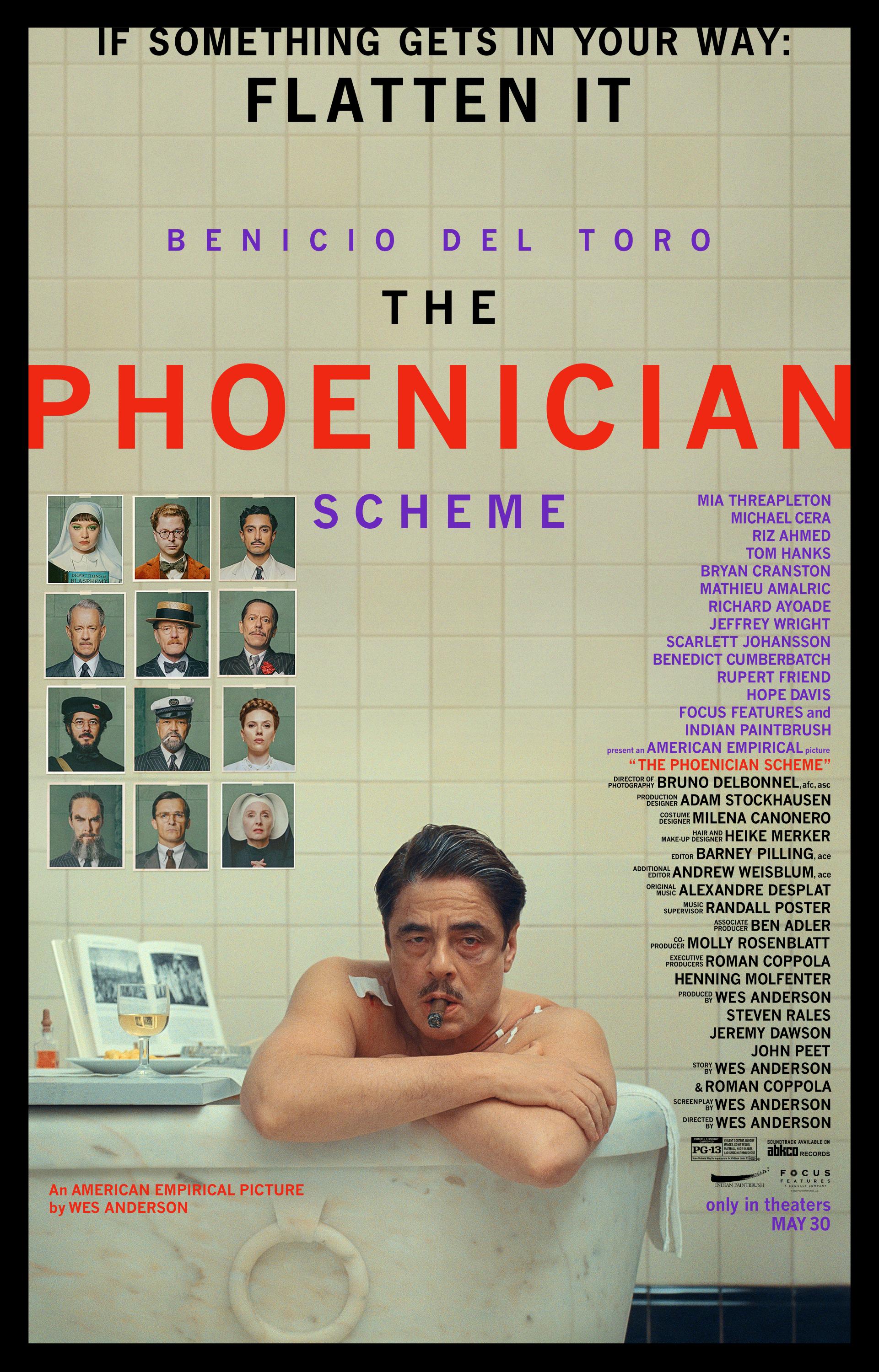
Zsa-Zsa Korda (Benicio Del Toro) is a wealthy businessman known for less than scrupulous practices. That’s why people are constantly trying to assassinate him. He’s in the process of carrying out a complex infrastructure scheme that involves tricky negotiations with various dignitaries and fellow moneymen. To help, he brings in his estranged daughter Liesl (Mia Threapleton), a novitiate who believes Zsa-Zsa may have murdered her mother. Accompanying them on their travels is Bjørn Lund (Michael Cera), a bug expert and tutor who takes a shine to Liesl.
Pushing the deal through puts the team in contact with a motley assortment of people: a panicked prince (Riz Ahmed), two cranky, basketball-loving businessmen (Tom Hanks and Bryan Cranston), an eccentric nightclub owner (Mathieu Amalric), an investor (Jeffrey Wright) who lives on a ship, and Korda’s second cousin, Hilda (Scarlett Johansson), who he considers making his wife. There’s also Uncle Nubar (Benedict Cumberbatch), Zsa-Zsa’s half-brother and a major potential roadblock to the deal’s completion.
On the surface, The Phoenician Scheme delivers a lot of what you’d expect from a Wes Anderson picture, from extremely precise framing, to elaborate dolly shots, to stylized dialogue. (“Help yourself to a hand grenade” deserves to become one of 2025’s biggest cinematic catchphrases.) The director shoots in a boxy 1.48:1 aspect ratio and there are black-and-white sections set outside the pearly gates of Heaven to illustrate Liesl’s positive impact on her father. Plus, Bill Murray as God.
These elements are utilized to illustrate the changing dynamic between Zsa-Zsa and Liesl. The pious nun-in-training becomes ever so slightly corrupted by his devious ways, her conservative façade gradually showing cracks. He, on the other hand, is swayed by her morality. It’s a big deal when he changes his plan to use slave labor, choosing to pay the slaves instead. (Another humorously off-kilter touch.) Neither acknowledges this change; they simply evolve from being in each other’s life. We notice it, though, and one of the film’s biggest pleasures is watching how things unfold.
Benicio Del Toro is outstanding in the main role, creating a character who is comically ruthless, yet not without a tender side. The special quality about Zsa-Zsa is that he unconditionally accepts his status as a scoundrel. Even as he grows, there is never a moment where he pretends to be anything other than what he is. Mia Threapleton – a dead ringer for her mother, Kate Winslet – delivers dialogue in a hilariously deadpan manner, while Michael Cera’s Norwegian accent turns Bjørn into a memorably comedic figure. Each of the supporting players brings an idiosyncratic touch to help the story come alive.
The Phoenician Scheme is probably a little less commercially mainstream than Asteroid City or Moonrise Kingdom. Anderson goes full-bore with his unique vision here. But once again, he has made a bold, distinctive film that draws you into its emotional core with offbeat humor and amusingly inventive visuals. It fits beautifully into his body of work, earning must-see status for viewers with appreciation for his contributions to cinema.
out of four
The Phoenician Scheme is rated PG-13 for violent content, bloody images, some sexual material, nude images, and smoking throughout. The running time is 1 hour and 41 minutes.
© 2025 Mike McGranaghan