Charlie Harper
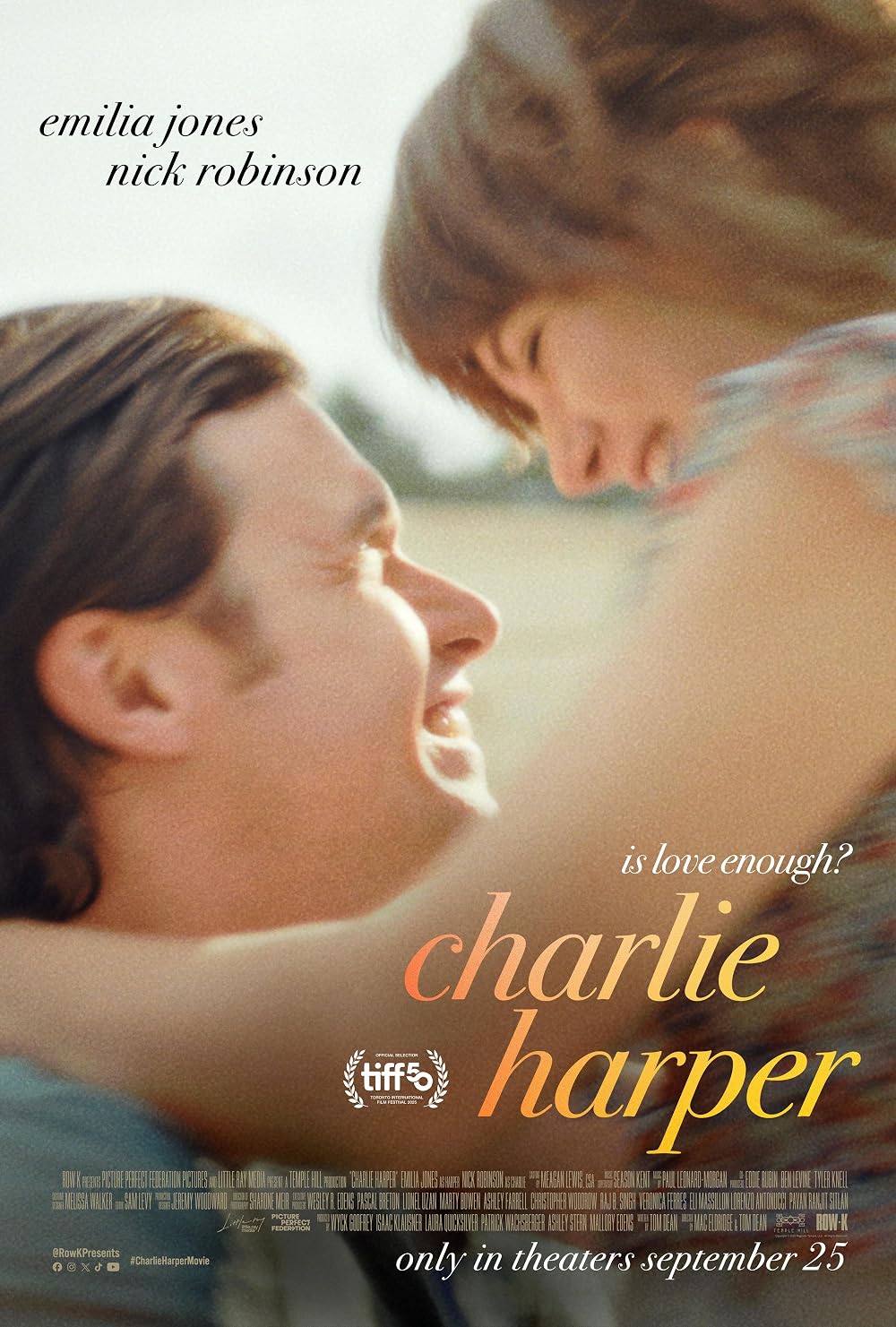
Charlie Harper gets its title from the names of its main characters. Charlie (Nick Robinson) is incredibly smart but just as incredibly aimless. Harper (CODA’s Emilia Jones) is an aspiring chef. Over the course of 102 minutes, they meet, fall in love, break up, reconcile, and break up again – although not necessarily in that order.
The movie charts their relationship from its earliest days, when he’s a teacher’s assistant and she’s the pretty student he can’t stop staring at. Chemistry between them is strong enough that they anticipate spending the rest of their lives together. Several obstacles threaten the bond. His alcohol problem, combined with low ambition, clashes with her professional drive. At the core, we can tell these two people love each other deeply. Life circumstances test them, and we wait to see whether their love can hold strong in the face of difficulties.
The story unfolds by jumping between time frames, with the aspect ratio changing to let us know what period we’re in. Because of the non-linear plotting, scenes we’ve watched often don’t make sense until later, when we’re given the full context. Nevertheless, directors Tom Dean and Mac Eldridge generally take care in the placement of those scenes, so that their ends and beginnings line up in some manner. By the end, we have a complete picture of the romance and can see how/why it took the turns that it did.
Charlie Harper is very much an actor’s showcase, giving the leads a lot of emotional content to work with. Robinson credibly takes Charlie through a range of feelings – from infatuation to bitterness - while making clear that his real problem is with himself. He’s smart enough to know that he’s underachieving, and it ticks him off. Jones once again proves to be a powerhouse. Her performance is heartbreaking, as Harper watches the man she loves gradually turn into someone else due to alcohol abuse. The actress has an amazing scene where her character tearfully confesses her romantic problems to a stranger. It’s a stark contrast to the fun, charming Harper we see in the early-stage sequences.
I had a strange reaction to this movie. While I was watching it, I couldn’t escape the feeling that it was just a little too precious. A fair amount of the dialogue sounded like the voice of a screenwriter. The crosscutting seemed a tad pretentious, especially compared to 2009’s excellent (500) Days of Summer, which similarly tells a breakup story out of order. I was enjoying the acting without really being bowled over by the film itself. Then, in the last 15 minutes or so, as the disparate pieces finally clicked into place, I found myself getting choked up. The story had hit a nerve I didn’t realize it was hitting. I couldn’t get it out of my head for a few days afterward.
That is what I would say to someone considering seeing Charlie Harper. You won’t necessarily know the movie’s impact until it’s over. Not everything succeeds, but you have to wait until the very end to assess your reaction. If it isn’t moving you in the moment, be patient. By the time the end credits roll, you will have witnessed a beautiful tale about a young man and a young woman trying to figure themselves out individually at the same time that they’re to figure themselves out together.
out of four
Charlie Harper is rated R for language, some sexual content, and drug use. The running time is 1 hour and 42 minutes.
© 2026 Mike McGranaghan