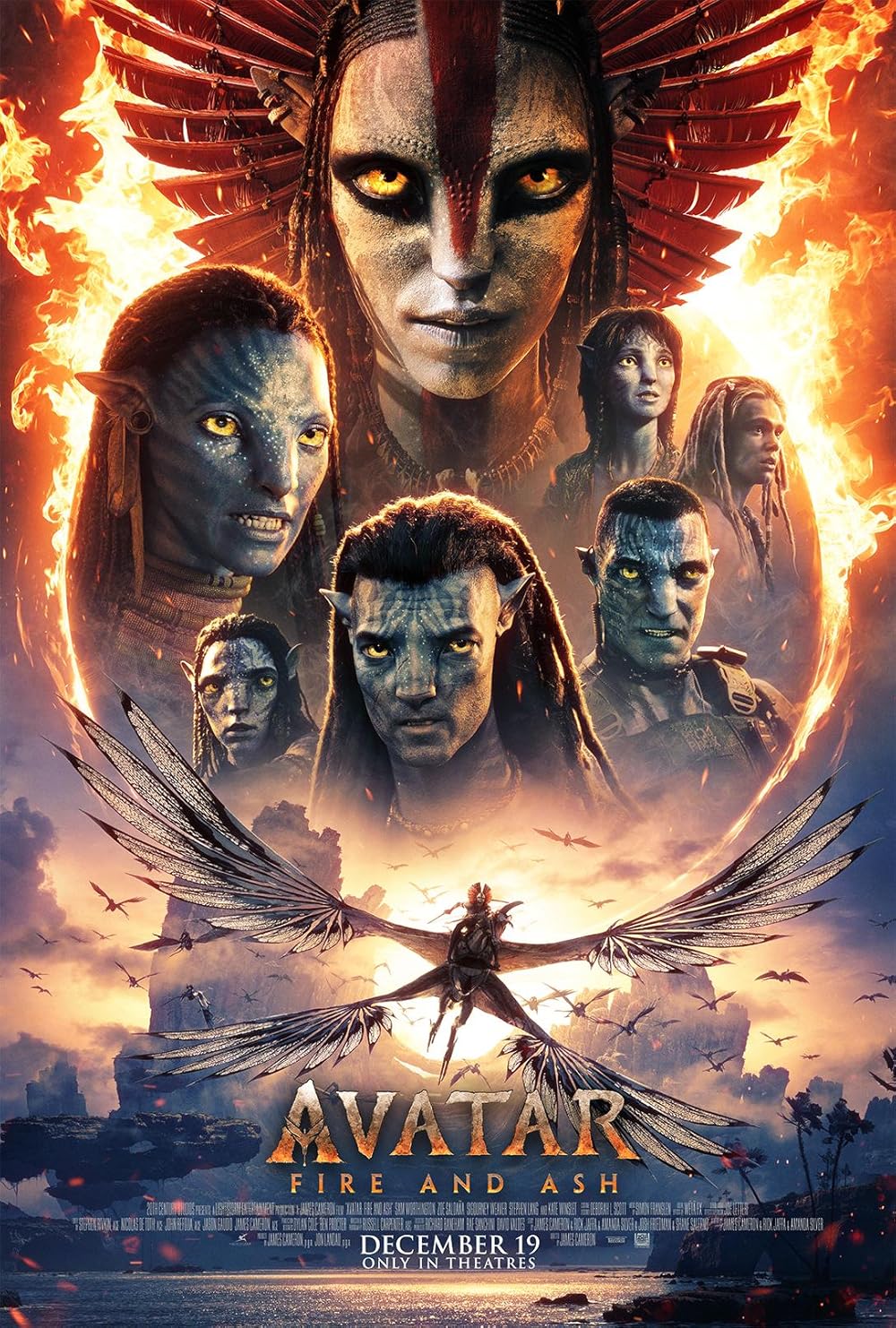
Avatar: Fire and Ash
Some people balk at long movies. Personally, I welcome them (as long as they’re good, of course). Avatar: Fire and Ash is the longest entry in James Cameron’s franchise, clocking in at 3 hours and 15 minutes. The length is baked into the core premise, as is the use of 3D. Both help to plunge viewers into his fictional world of Pandora and deliver massive action sequences. Settling into a comfortable cinema seat to be transported that way for an afternoon sounds pretty good to me.
Cameron builds nicely on what he previously established in Avatar and Avatar: The Way of Water. Hero Jake Sully (Sam Worthington) and his family face a new enemy: the ash people, led by the ruthless Varang (Oona Chaplin). These banshee-like warriors utilize flaming arrows in combat. Col. Quaritch (Stephen Lang) is also lurking around, hoping to capture his son Spider (Jack Champion). Together with wife Neytiri (Zoe Saldaña), Jake leads the charge to protect their people.
We don’t get a lot of epic storytelling on this level anymore. Pandora keeps revealing unseen areas of itself, and the relationships between the many characters take on complex dimensions. Varang’s arrival dramatically alters the dynamic, especially once she lays eyes on Quaritch’s fancy weapons. Spider goes through a change that makes it essential for Quaritch to find him. The villains team up, meaning Sully and crew must take on two powerful enemies that, combined, outnumber them. Seeing how he and Neytiri adapt to the evolving threat is one of the movie’s most exciting pleasures.
The action sequences are just as incredible in Fire and Ash as they were in the two previous entries. Early on, there’s a scene where the ash people attack, leading to a dizzying aerial battle. Squid-like creatures bring a fresh aspect to the water-based melees. As always, Cameron pulls out all the stops for the finale, delivering a final 40 minutes that are jam-packed with ingeniously conceived mayhem, most notably a harrowing fight between Jake and Quaritch that finds them clinging to floating rocks and dangling from vines. Because the characters and situations have been so carefully developed, these scenes carry real weight. The stakes are just as high for the bad guys as they are for the heroes.
Oona Chaplin deserves special credit for her performance as Varang. Effects artists have made the character genuinely scary looking, but the actress’s physicality and vocal tone prove equally impactful. Varang is consequently one of the best new cinematic antagonists of recent years.
3D adds immeasurably to the overall effect. When the characters are in the air, you feel like you are, too. When they’re underwater, the vastness of the ocean is palpable. Arrows come flying off the screen, bullets whiz past your head, and you might find yourself ducking when Varang gets her hands on a flamethrower. More importantly, the 3D makes the landscapes of Pandora come alive. Cameron understands how to use it in a manner that’s fully immersive without seeming gimmicky. It’s no exaggeration to say you exit the theater feeling as though you’ve immerged from another planet.
Excess is clearly the name of the game here. Everything that worked about the two previous movies works again here, whereas the new elements augment what we already know about this world. Avatar: Fire and Ash is spectacular fun as a result. For three-and-a-quarter hours, you leave reality behind to enter this visually beautiful place where thrilling adventures occur. Nothing else matters during that time. Like its predecessors, this is more than a movie; it’s a full-on experience of sight, sound, and emotion.
out of four
Avatar: Fire and Ash is rated PG-13 for intense sequences of violence and action, bloody images, strong language, thematic elements, and sexual material. The running time is 3 hours and 15 minutes.
© 2025 Mike McGranaghan