Animal Farm
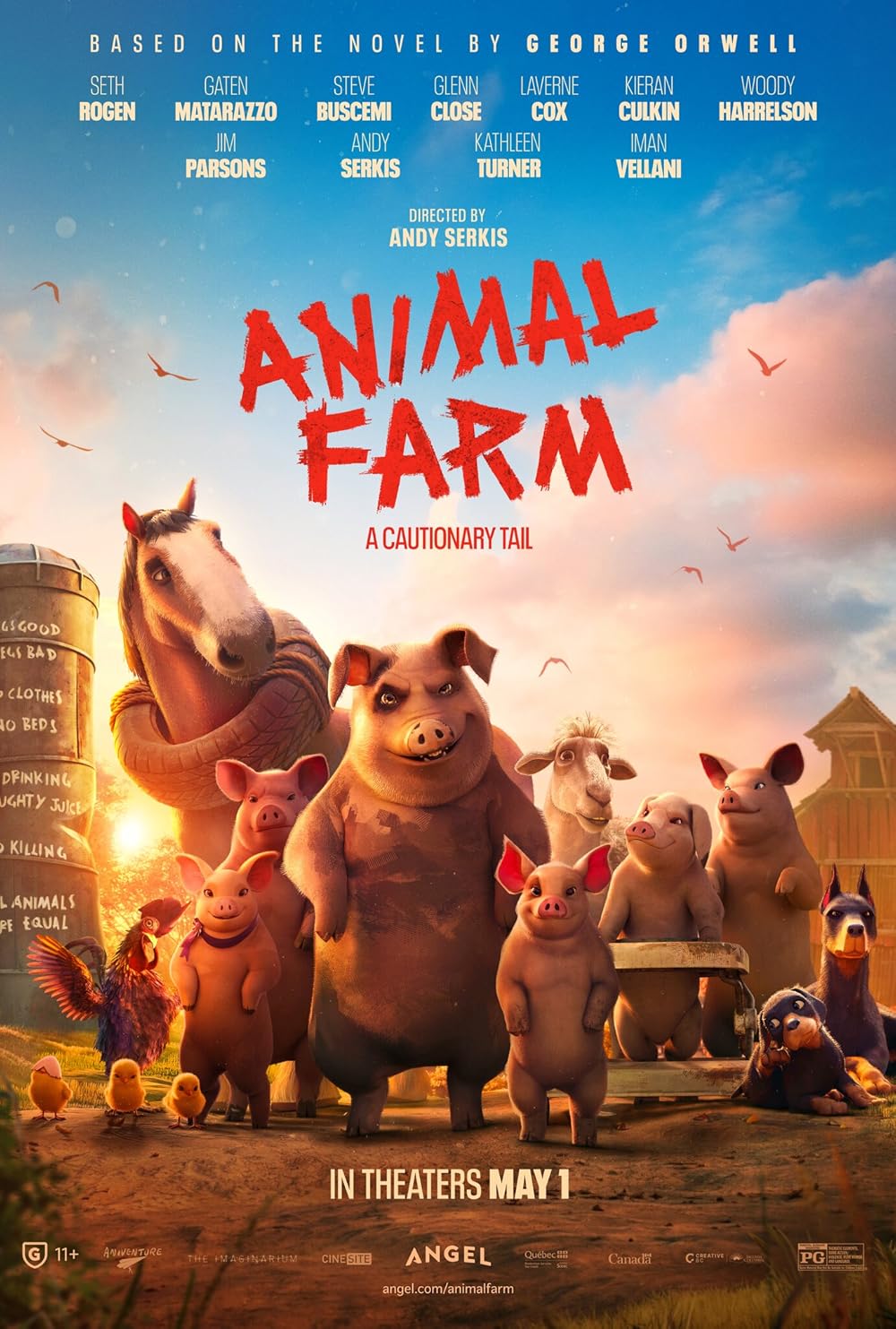
I would love to know what the people who made the animated Animal Farm were thinking when they embarked upon this endeavor. Here is a movie so misguided that its existence doesn’t make sense. It’s an adaptation of George Orwell’s classic novella, aimed at children. Because what kid doesn’t love a good satire of totalitarianism? Even odder, it changes Orwell’s story, turning it into something hopeful and therefore removing its sting.
Although narrated by workhorse Boxer (Woody Harrelson), the movie adds a protagonist - a small pig named Lucky (Gaten Matarazzo). He lives on a farm with a bunch of other animals. They collectively chase the farmer away after he attempts to sell them to a slaughterhouse. A sow called Snowball (Laverne Cox) steps up as leader, suggesting a series of rules that will benefit all the animals. Pig Napoleon (Seth Rogen) repeatedly skirts those rules, eventually seizing control of the farm and making choices to benefit his species exclusively. Lucky finds himself caught in the middle.
The overall gist of Animal Farm is retained from Orwell’s book, as Napoleon’s actions lead to a system as unbeneficial to his fellow animals as the farmer’s was. Several of the key lines are also retained, like “All animals are created equal, but some are more equal than others.” Otherwise, director Andy Serkis and screenwriter Nicholas Stoller try to “hip up” the material to appeal to kids. The anti-authoritarian tale is peppered with a fart joke, a human character stepping in cow dung, and a reference to someone peeing their pants. The animals dance to hip-hop music and visit a large department store, where they buy tablets, headphones, and assorted other electronic devices.
Okay, so maybe the filmmakers are trying to use those things to get today’s youth audience to pay attention. Fine. The didactic dialogue utilized by the characters will have young ones zoning out quickly. A great deal of effort is expended underlining every single point the story tries to make. This comes at a cost, as character development is simplistic at best and the flow of the plot is continually halted by the need to elucidate the themes. In other words, it feels an awful lot like being lectured to.
The new ending lectures the audience in a different manner. Serkis, who claims to have gotten the approval of Orwell’s estate to make changes, tries to deliver an optimistic message in the film’s final minutes. To a degree, it’s understandable why - he doesn’t want to send children out of the theater on a discouraging note. Then again, why adapt this particular work if you’re just going to undermine Orwell’s basic intent? Why not come up with an original story instead? Slapping an upbeat ending on Animal Farm is like adding a coda to Se7en where it’s implied Brad Pitt’s character might remarry again someday.
About the best that can be said is that the picture is nicely animated. Beyond that, it’s kind of a mess, with unfunny jokes, inane action sequences, and truly uninspired new elements. (I haven’t even mentioned the villainous real estate tycoon, voiced by Glenn Close, who monitors the animals via her drone army.) Worst of all, Serkis and Stoller demonstrate a fundamental misunderstanding of the power in the tale they’re translating to the screen.
out of four
Animal Farm is rated PG for thematic elements, some action/violence, rude humor, and language. The running time is 1 hour and 36 minutes.
© 2026 Mike McGranaghan