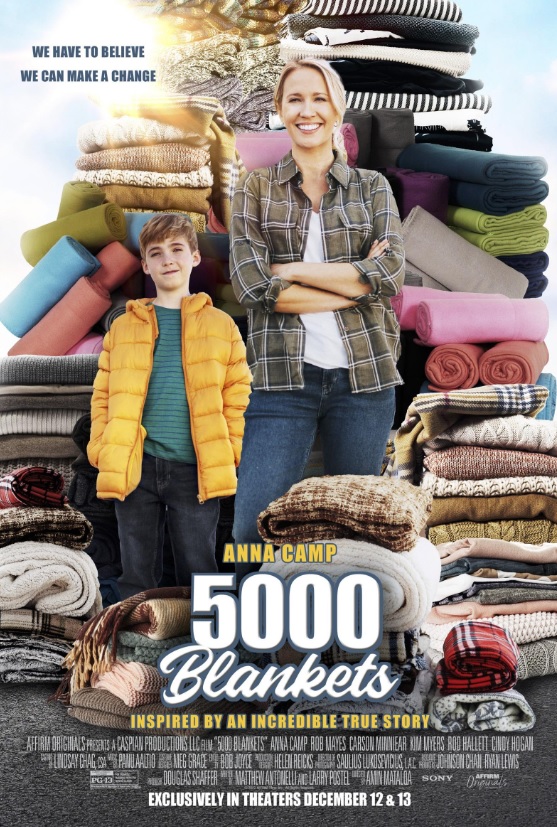
5000 Blankets
5000 Blankets is a very nice, well-intentioned movie that almost works, yet doesn't quite get there. When you hear the true story that provides the basis for this faith-based release, it's easy to think it's a natural for the big-screen treatment. There isn't as much story there as it initially seems, though, which leaves the film treading water for quite a while before finally getting to the good stuff. The last half-hour is undeniably touching. Everything before that is a bit spotty.
Cyndi Saunders (Anna Camp) lives in Texas with her husband Bobby (Rob Mayes) and young son Phillip (Carson Minniear). Life is okay until Bobby's mental health issues begin to flare up. After Cyndi literally talks him down off a ledge, he hops in his pickup truck and drives off. Months go by without him re-emerging. Searching puts mother and son in contact with some of the city's homeless citizens. Realizing brutal winter temperatures are approaching and Bobby is out there somewhere, Cyndi and Phillip come up with the idea to collect blankets to disperse. Getting people to donate them is easy; devising a viable means of handing them out proves more difficult.
Watching people donate and collect blankets isn't the most dramatic thing a movie can show. Therefore, a fair amount of time is spent on the Bobby issue. He has “movie mental illness” - that unspecified, non-descript ailment characters have when filmmakers need to use mental health problems as a plot point, but either don't know enough about the subject or don't care enough to show it realistically. Bobby's diagnosis, whatever it's supposed to be, has one symptom, which is that it causes him to run around in a daze. We're asked to believe that, over the course of several months, he never once has a moment of clarity that allows him to call his family, go home, or seek help. Even in the one scene where he does end up outside a clinic, he freaks out and runs off again. The half-hearted portrayal of his plight weakens 5000 Blankets as a whole.
Where it fares best is in the third act, as Cyndi and Phillip begin their effort in earnest. Scenes showing homeless people gratefully wrapping themselves up in warm blankets serves as an uplifting reminder of the small acts we can perform to help our fellow man. Those acts may be relatively minor to us, but they're potentially life-altering to the recipients. Through Cyndi's passion for the project, others around her become inspired to help, causing a movement to grow. As weak as the mental health part of the movie is, the part depicting how a charitable idea can grow into something profound is nothing short of inspirational. You might be motivated to find a similar activity in your own community afterward.
Anna Camp is very good here, conveying the array of emotions Cyndi experiences over the course of the story. During times when she's worrying about Bobby, the actress makes that concern sincere. And when she's struggling to figure out what to do with all those blankets, the motivation feels like it's coming from a genuine place. Camp additionally allows the character's religious faith to be relatable. She avoids the heavy-handed tone often felt in films of this variety.
5000 Blankets is best when it sticks to Cyndi's story. When it gets into Bobby's struggle or a forced, unconvincing friendship she and Phillip form with a homeless woman, it falters. (The character is basically present to provide an easy solution when blankets need to be sewn.) In the end, the picture is a mixed bag, filled with admirable intentions and a compassionate message, while intermittently falling victim to flat storytelling.
out of four
5000 Blankets is rated PG-13 for thematic material involving mental illness. The running time is 1 hour and 45 minutes.