28 Years Later
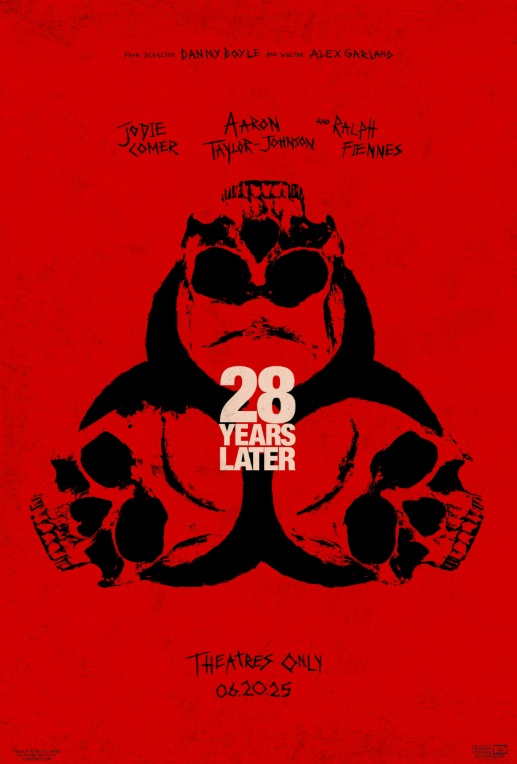
It’s been 23 years since director Danny Boyle and writer Alex Garland made 28 Days Later and 18 years since Juan Carlos Fresnadillo continued the franchise with 28 Weeks Later. Now Boyle and Garland resume control, bringing us 28 Years Later, the best and most thematically rich of the trio, not to mention the one most filled with zombie genitalia. Seriously, the fact that a particularly muscular infected guy is visibly well-endowed adds to his creepiness factor. The movie makes all the muscles in your body clench up for a large portion of its running time but takes a few surprising steps that are really special.
The “rage virus” that turns people into aggressive zombie-like creatures has been contained to Great Britian. A group of survivors lives on a small island that’s connected to the mainland by a tidal causeway. Jamie (Aaron Taylor-Johnson) takes his 12-year-old son Spike (Alfie Williams) across that causeway to teach him how to kill the infected with a bow and arrow. Once Spike has a few slayings under his belt, he decides to make an unsanctioned trek with his sickly mother Isla (Jodie Comer) to find Dr. Kelson (Ralph Fiennes), a former general practitioner who Jamie claims has gone crazy. Maybe he can treat her, or maybe he’s a psychopath. They won’t know until they get there. Encounters with the infected come regularly.
Several new elements are introduced in this sequel. In addition to the rapid editing and high frame rate camera technique used in the attack sequences, Boyle now employs a speeded-up version of the “bullet time” effect from The Matrix when an infected person gets speared. That helps make the gory violence even more visceral. Another new addition is the presence of “Alphas,” exceptionally large and lethal infected mutants. One of them – the guy with the intimidatingly massive penis – looks like the already ripped Jason Momoa jacked up on steroids. Every time he comes onscreen, the story’s anxious tension increases.
On that basic blood-and-guts level, 28 Years Later delivers the goods. This is a grim, gory, and grimy horror flick that offers a multitude of disgusting sights. The concept of a rage virus has never felt as threatening as it does here. But Garland’s screenplay does more, taking care to develop the characters and including moments designed to emphasize the human loss created by the virus. In the most unforgettable scene, Spike and Isla have an encounter in an abandoned train car that starts off creepy, grows heartbreaking, then becomes even gnarlier than it was at the beginning.
The last act has an emotional impact, too. What Fiennes does with his character is genuinely compelling, as is Dr. Kelson’s function within the plot. Until the climactic action scene, this is the quiet part of the film, although it is no less gripping because of its quietness. Given the frenetic pace of the series, an elegiac section is unexpected, and yet it’s every bit as haunting as the scare scenes.
Taylor-Johnson, Comer, Fiennes, and Williams are across-the-board interesting to watch in various configurations, and the excellent sound design and musical score contribute to the tense mood Boyle generates. A spooky old recording of Rudyard Kipling’s poem “Boots” is played early on to set the tone. 28 Years Later is a super-intense movie that rattles your nerves because of the story’s substance as much as its gore.
out of four
28 Years Later is rated R for strong bloody violence, grisly images, graphic nudity, language, and brief sexuality. The running time is 1 hour and 55 minutes.
© 2025 Mike McGranaghan